Michel Foucault
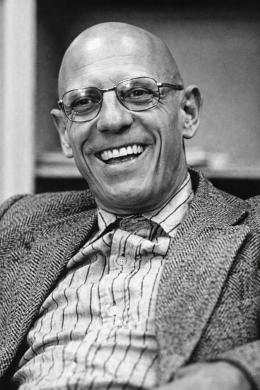

- Madness and Civilization (1961)
- The Order of Things (1966)
- Discipline and Punish (1975)
- The History of Sexuality (1976–1984)
Michel Foucault (1926–1984) was a French philosopher, historian, and theorist whose analyses of power, discourse, and subjectivity fundamentally reshaped the conceptual landscape of psychoanalysis. By interrogating the historical conditions of knowledge, madness, sexuality, and the subject, Foucault’s work provided both a critical genealogy and a set of theoretical tools that influenced and challenged the traditions of Freud and Lacan, as well as their successors.
Intellectual Context and Biography
Foucault’s intellectual trajectory unfolded within the context of postwar French philosophy, marked by the ascendancy of structuralism, the legacy of phenomenology, and the political ferment of the 1960s and 1970s. His work traversed philosophy, history, psychiatry, and social theory, always with an eye to the ways in which knowledge and power are intertwined.
Early Formation
Foucault’s early education was shaped by the French philosophical tradition, especially through his studies at the École Normale Supérieure. He was influenced by figures such as Jean Hyppolite (noted for his readings of Hegel and mediation of German philosophy into French thought), Georges Canguilhem (whose work on the history of science and the concept of the norm deeply marked Foucault’s approach), and Maurice Merleau-Ponty. Foucault’s initial encounters with psychology and psychiatry, as well as his engagement with Nietzsche and Heidegger, oriented his thinking toward the historical and critical analysis of knowledge.
Major Turning Points
Foucault’s first major work, Madness and Civilization, signaled a break with traditional histories of ideas by focusing on the institutional and discursive construction of madness. Subsequent works, such as The Birth of the Clinic and Discipline and Punish, extended this method to medicine and the penal system, respectively. The publication of The Archaeology of Knowledge marked a methodological shift, while The History of Sexuality introduced the concept of biopolitics and a sustained critique of the “repressive hypothesis” regarding sexuality. Throughout, Foucault’s intellectual development was characterized by a refusal of stable disciplinary boundaries and a commitment to genealogical critique.
Core Concepts
Foucault’s theoretical innovations are best understood through several interrelated concepts that have become central to contemporary theory and psychoanalysis.
Power/Knowledge
Foucault rejected the traditional separation of power and knowledge, arguing instead that they are mutually constitutive. Power is not merely repressive but productive, shaping the very conditions of possibility for knowledge, subjectivity, and social relations.[1] This insight destabilized psychoanalytic accounts that posited a pre-existing subject or unconscious, emphasizing instead the historical formation of both.
Discourse
For Foucault, discourse is not simply language or speech but a system of rules, practices, and institutions that produce and regulate knowledge and subjectivity.[2] Discourses define what can be said, thought, and done within a given historical period. This concept provided psychoanalysis with new tools for analyzing the social and historical construction of desire, sexuality, and the unconscious.
Archaeology and Genealogy
Foucault distinguished between “archaeology”—the analysis of the historical a priori that structures fields of knowledge—and “genealogy”—the investigation of the contingent, power-laden processes that produce subjects and norms.[3] Both methods have been taken up by psychoanalytic theorists seeking to historicize the emergence of psychic structures and social norms.
Biopolitics and Governmentality
In his later work, Foucault introduced the concepts of biopolitics and governmentality to describe the ways in which modern power operates through the regulation of bodies, populations, and forms of life.[4] These concepts have been influential in psychoanalytic debates about the social and political dimensions of subjectivity, desire, and the body.
Relation to Psychoanalysis
Foucault’s relation to psychoanalysis is complex, involving direct critique, structural transformation, and mediated influence.
Freud and the Historicization of Psychoanalysis
Foucault’s early work, especially Madness and Civilization, situates Freud within a broader history of the medicalization and institutionalization of madness.[5] He challenges the universality of psychoanalytic categories, arguing that concepts such as the unconscious and sexuality are historically contingent rather than transhistorical. Foucault’s genealogy of sexuality, in particular, problematizes Freud’s “repressive hypothesis,” suggesting that modern societies have not simply repressed sexuality but have produced it as an object of knowledge and regulation.[6]
Lacan and the Question of the Subject
Foucault and Lacan, though contemporaries, developed divergent accounts of subjectivity. While Lacan’s “return to Freud” emphasized the structuring role of language and the symbolic order, Foucault historicized the very conditions under which the subject emerges as a category.[7] Lacan’s notion of the subject “barred” by language finds a structural echo in Foucault’s analyses of discursive formation, but Foucault’s genealogical method resists the universalization of psychoanalytic structures. The two thinkers engaged in polemical exchanges, with Foucault critiquing the psychoanalytic subject as a product of specific historical regimes of knowledge and power.[8]
Mediated and Structural Influence
Foucault’s influence on psychoanalysis was often mediated through shared interlocutors, such as Jean Hyppolite and Louis Althusser, who shaped both Lacan’s and Foucault’s engagements with Hegel, Marx, and structuralism. Foucault’s concepts of discourse and power/knowledge provided psychoanalytic theorists with new frameworks for analyzing the social field, the formation of desire, and the historicity of the unconscious.[9]
Reception in Psychoanalytic Theory
Foucault’s work has been both appropriated and contested within psychoanalytic circles. Jacques-Alain Miller and other Lacanians have engaged critically with Foucault’s historicization of the subject, debating the compatibility of genealogy with psychoanalytic structuralism.[10] Julia Kristeva drew on Foucault’s analyses of discourse and power in her theorization of abjection and the semiotic.[11] Slavoj Žižek, while critical of Foucault’s alleged neglect of the Real, nonetheless acknowledges the importance of Foucault’s critique of ideology and his analysis of disciplinary power.[12] Judith Butler’s work on gender performativity and the regulation of bodies is deeply indebted to Foucault’s concepts of discourse and governmentality.[13] Debates continue regarding the compatibility of Foucault’s genealogical method with psychoanalytic theory, especially concerning the status of the subject and the unconscious.
Key Works
- Madness and Civilization (1961): A genealogy of the social and institutional construction of madness, historicizing the emergence of psychiatry and problematizing the psychoanalytic category of the unconscious.
- The Birth of the Clinic (1963): An analysis of the medical gaze and the transformation of bodies into objects of knowledge, relevant for psychoanalytic theories of the body and subjectivity.
- The Archaeology of Knowledge (1969): Foucault’s methodological treatise on discourse analysis, providing tools for psychoanalytic investigations of language and knowledge.
- Discipline and Punish (1975): A study of the emergence of disciplinary power and the production of docile bodies, influential for psychoanalytic accounts of social regulation and the superego.
- The History of Sexuality, Vol. 1 (1976): A critique of the repressive hypothesis and a genealogy of sexuality, challenging psychoanalytic assumptions about repression and desire.
- Society Must Be Defended (1976): Lectures introducing the concept of biopolitics, with implications for psychoanalytic theories of the body, life, and power.
Influence and Legacy
Foucault’s impact on psychoanalysis is profound and multifaceted. His analyses of power, discourse, and subjectivity have reshaped the way psychoanalysts and theorists approach the unconscious, desire, and the social field. By historicizing the emergence of psychoanalytic categories, Foucault challenged their universality and opened new avenues for critical inquiry. His concepts of biopolitics and governmentality have influenced debates on the regulation of bodies, sexuality, and identity. Beyond psychoanalysis, Foucault’s legacy extends to philosophy, political theory, gender studies, and the history of science, where his genealogical method and critique of modernity continue to inspire and provoke.
See also
References
- ↑ Foucault, Michel. Discipline and Punish. New York: Vintage, 1977.
- ↑ Foucault, Michel. The Archaeology of Knowledge. New York: Pantheon, 1972.
- ↑ Foucault, Michel. Nietzsche, Genealogy, History. In Language, Counter-Memory, Practice, edited by Donald F. Bouchard. Ithaca: Cornell University Press, 1977.
- ↑ Foucault, Michel. The History of Sexuality, Vol. 1. New York: Vintage, 1978.
- ↑ Foucault, Michel. Madness and Civilization. New York: Vintage, 1965.
- ↑ Foucault, Michel. The History of Sexuality, Vol. 1.
- ↑ Foucault, Michel. The Order of Things. New York: Vintage, 1970.
- ↑ See Jacques-Alain Miller, “Action of Structure,” in Lacanian Ink 8 (1996).
- ↑ See Julia Kristeva, Powers of Horror: An Essay on Abjection. New York: Columbia University Press, 1982.
- ↑ See Miller, “Action of Structure.”
- ↑ Kristeva, Powers of Horror.
- ↑ Žižek, Slavoj. The Sublime Object of Ideology. London: Verso, 1989.
- ↑ Butler, Judith. Gender Trouble. New York: Routledge, 1990.