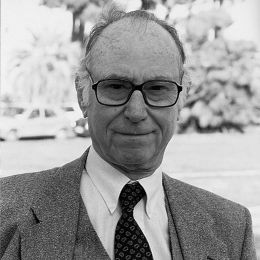
André Green
André Green (March 12, 1927 – January 22, 2012) was a French psychoanalyst, psychiatrist, and philosopher who stands as one of the most significant figures in the development of post-Lacanian psychoanalysis. Often described as the "Great Synthesizer" or the architect of a "Contemporary French Freudianism," Green’s work represents a sophisticated "Third Way" that bridged the structuralist rigor of Jacques Lacan, the clinical intuition of British object relations (specifically Donald Winnicott and Wilfred Bion), and a staunch return to Freudian drive theory.

- Le Discours vivant (1973)
- The Tragic Effect (1979)
- On Private Madness (1986)
- The Work of the Negative (1993)
- Key Ideas for a Contemporary Psychoanalysis (2005)
- Key Ideas for a Contemporary Psychoanalysis: Misrecognition and Recognition of the Unconscious (2005)
Green is best known for his exploration of the "Work of the Negative"—a meta-theory of psychic life centered on absence, loss, and the "unbinding" of thought. His seminal concept, the Dead mother complex, revolutionized the treatment of borderline and narcissistic patients by shifting focus from Oedipal conflict to the trauma of emotional withdrawal. Institutionally, Green served as a vital anchor for the Société Psychanalytique de Paris (SPP) and the International Psychoanalytical Association (IPA), ensuring that French psychoanalysis remained globally engaged during the sectarian fractures of the 1960s and 70s.
I. Early Life and Intellectual Formation (1927–1953)
The Egyptian Matrix
André Green was born in Cairo, Egypt, to a Sephardic Jewish family. His upbringing in a multilingual, cosmopolitan environment—where French, Arabic, and English coexisted—provided him with what he later termed a "peripheral perspective" on Western intellectual culture. This "outsider" status proved essential in his later years, allowing him to navigate the dogmatic "sectarianism" of the Parisian psychoanalytic scene with a certain detachment.[1]
Green’s migration to Paris after World War II to study medicine was marked by an early interest in the intersection of biology and philosophy. He was deeply influenced by the French tradition of phenomenology, particularly the work of Maurice Merleau-Ponty, which grounded his eventual insistence that the unconscious must be understood as a "living" corporal experience rather than a purely linguistic structure.
Sainte-Anne and the Psychiatric Revolution
Green received his psychiatric training at the Hôpital Sainte-Anne, the epicenter of French psychiatric thought in the 1950s. He studied under Henri Ey, the "Pope of French Psychiatry," whose "organo-dynamic" theory sought to unify the organic brain with the dynamic movements of the mind. At Sainte-Anne, Green worked with patients suffering from severe psychosis and melancholia, clinical experiences that would later inform his theories on the "Negative" and the "White" (blank) states of the psyche. It was also at Sainte-Anne that Green first attended the seminars of a then-rising star in the analytic world: Jacques Lacan.
II. The Lacanian Decade and the "Living" Rupture (1953–1963)
The Allure of Structuralism
From 1953 to 1963, Green was a member of Lacan’s inner circle. He was profoundly attracted to Lacan’s "Return to Freud," which critiqued the adaptive, social-conformist tendencies of Anglo-American Ego psychology. Green initially championed Lacan’s emphasis on the Symbolic order, the role of language, and the rejection of a "harmonious" ego. He credited Lacan with rescuing psychoanalysis from a purely medicalized or developmental framework.
The Bonneval Colloquium (1960): The First Crack
The intellectual honeymoon with Lacanianism began to fray at the 1960 Bonneval Colloquium on the Unconscious. At age 33, Green presented a paper, "The Unconscious: A Psychoanalytic Study," which staged a daring challenge to Lacan’s core dictum: "The unconscious is structured like a language."
Green argued that by reducing the unconscious to the "logic of the signifier," Lacan was producing a "bloodless" psychoanalysis. For Green, the unconscious was not merely a chain of words; it was a "pulsating discourse" composed of Affect and Drive—biological forces that press against the mind and cannot be fully translated into speech.[2] This insistence on the "Vibrancy" of the body marked Green as the leader of a burgeoning "Post-Lacanian" movement that sought to put the "flesh" back onto the structuralist skeleton.
The 1963 "Excommunication" and Institutional Choice
The definitive break occurred in 1963, when the IPA refused to recognize Lacan as a training analyst, leading to Lacan’s departure to found the École Freudienne de Paris (EFP). Unlike many of his peers, such as Jean Laplanche or Serge Leclaire, Green chose to remain within the Société Psychanalytique de Paris (SPP).
This was a profoundly political and ethical choice. Green argued that Lacan’s new school risked becoming a "cult of personality" that abandoned the necessary "analytic frame" (the standard setting) in favor of the "short session." By staying in the SPP, Green took on the role of an internal reformer: he wanted to keep French psychoanalysis intellectually rigorous (Lacanian) but institutionally stable and clinically grounded (Freudian/IPA). For this "betrayal," Green was targeted with vitriolic scorn by the Lacanian youth, an experience he later described as a "painful divorce" from his intellectual father figure.
III. The Great Synthesis: Reclaiming the Affect
The Critique of the Signifier
Following the break with Lacan, Green’s work in the late 1960s and early 70s was focused on reclaiming the status of the Affect. He argued that while the “Signifier” (the word) represents the unconscious, the “Affect” is the unconscious in its state of being.
In his landmark book, ‘’Le Discours vivant’’ (1973), Green proposed that the analytic session is a meeting of two “Living Discourses.” He criticized the Lacanian focus on the “Letter” as a form of intellectualized resistance. If a patient speaks without feeling, Green argued, they are not “in” analysis; they are merely producing a “dead” discourse. This led him to the study of those clinical states where the capacity to feel and to link thoughts has been destroyed—the realm of the “Negative.”
Transition to the British School
In the late 1960s, feeling intellectually stifled by the Parisian obsession with structuralism, Green began a series of “clandestine” trips to London. He sought out the work of Donald Winnicott and Wilfred Bion. At the time, French analysts largely viewed the British School as “infantile” or “pre-symbolic.” Green, however, saw in Winnicott’s “Transitional Object” and Bion’s “Container/Contained” the missing pieces of the Freudian puzzle.
He became a crucial bridge, introducing Winnicott’s concepts of the “Holding environment” and “Primary maternal preoccupation” to the SPP. This synthesis was not a simple adoption; Green “Gallicized” British thought, providing it with a rigorous metapsychological foundation that the more intuitive British analysts often lacked. This transatlantic dialogue would eventually culminate in his most famous clinical contribution: the Dead Mother complex.
IV. The Metapsychology of the Negative: A Deep Dive
The hallmark of André Green’s mature thought is his systematic investigation of the “Work of the Negative” (Le Travail du négatif). While Freud had touched upon negation in his 1925 paper ‘’Die Verneinung’‘, Green expanded this into a comprehensive metapsychological pillar. Drawing on the Hegelian dialectic—specifically the idea that the “spirit” gains its truth only by finding itself in absolute disruption—Green argued that the psyche is not merely a collection of representations, but a dynamic field governed by processes of absence, refusal, and unbinding.[3]
4.1 Productive vs. Destructive Negativity
Green distinguished between two forms of the negative. The “Productive Negative” is essential for psychic growth; it includes the capacity to say “no,” to differentiate self from other, and to create the “blank space” necessary for thought and symbolization. Without the ability to “negatively hallucinate” the mother’s constant presence, the infant would never develop the capacity to think of her in her absence.
Conversely, the “Destructive Negative” involves what Green termed Déliaison (unbinding). This is a manifestation of the Death drive, where the psyche does not merely repress painful thoughts but actively destroys the “links” between ideas, feelings, and objects. This leads to a state of psychic void or “whiteness,” where the mind becomes a desert of non-representation.
4.2 Negative Hallucination as a Framing Structure
One of Green’s most radical proposals was that Negative Hallucination—the act of not seeing what is present—is the prerequisite for all perception. He theorized that the maternal care-taking environment acts as a “frame” for the infant’s mind. When the mother is “erased” from the foreground but remains as a reliable background, she becomes the “Framing Structure” of the ego. This allows the subject to perceive objects without being overwhelmed by them. In borderline and psychotic states, Green argued, this frame has collapsed, leaving the subject unable to distinguish between the “container” of the mind and its “content.”
V. The Dead Mother Complex and “White Mourning”
In 1980, Green published his most celebrated clinical paper, “The Dead Mother” (La Mère morte), which fundamentally altered the psychoanalytic understanding of depression. Green clarified that the “Dead Mother” is not a mother who has physically died, but one who remains alive but has “psychically decathexed” (withdrawn interest from) the child, usually due to her own depression, bereavement, or trauma.[4]
5.1 The Psychic Catastrophe
The complex begins when an infant, who has previously experienced a loving and vital mother, suddenly encounters a mother who is emotionally “frozen.” The child, unable to understand this change, experiences a “psychic catastrophe.” To preserve the bond with the mother, the child “mummifies” her image within the psyche. This results in an identification with the “dead” object: the child becomes “dead” in their own affect to stay close to the mother.
5.2 White Mourning and the Void
Green termed this state “White Mourning” (Deuil blanc). Unlike classical Freudian melancholia, where the patient is angry with the lost object, the patient in a Dead Mother complex feels nothing but an agonizing sense of emptiness. The “Negative” here is not a conflict but a “hole” in the fabric of the self. Clinically, these patients often present with “flat” affects, a chronic sense of boredom, and a profound inability to love or be loved, despite appearing highly functional in their intellectual lives.
VI. Clinical Innovation: The Borderline Patient and Tertiary Processes
By the 1980s, Green had become the leading theorist on Borderline States (États-limites). He argued that these patients represent a “Non-Neurotic” structure that requires a modification of classical technique.
6.1 Analytic Depression
Green identified a specific form of suffering in borderline cases which he called “Analytic Depression.” This is not a depression caused by guilt (as in neurosis) but by the fear of “psychic holes” or the “leakage” of the self. In the analytic setting, these patients often experience the analyst’s silence not as a space for reflection, but as a terrifying “Negative Hallucination” that repeats the trauma of the Dead Mother.
6.2 Tertiary Processes
To treat these states, Green proposed the development of “Tertiary Processes.” Freud had divided the mind into Primary (unconscious/illogical) and Secondary (conscious/logical) processes. Green argued that the analyst must function as a “Third” who helps the patient create links between the two. The analyst must be more “vital” and active, providing “linking” interpretations that act as a bridge across the psychic void. This concept of Thirdness—the analytic relationship as a creative space that belongs to neither the analyst nor the patient alone—has since become a cornerstone of contemporary relational psychoanalysis.[5]
VII. Psychoanalysis vs. Deconstruction: The Dialogue with Derrida
Green’s intellectual reach extended far beyond the clinic, most notably in his complex engagement with Jacques Derrida. Both thinkers were obsessed with the concept of the “Trace” and the “Negative,” but they approached these from vastly different foundations.
7.1 The Louvre Encounter (1990)
The two met in a famous debate at the Louvre in 1990 titled “The Archive and the Unconscious.” Derrida, the father of Deconstruction, argued that the unconscious is essentially an “archive” of traces—a text that is always being re-written. Green, however, staged a powerful defense of the Freudian Drive. He argued that Derrida’s philosophy represented a “Psychical Drought” because it ignored the “pulsating” biological energy that fuels the mind.
7.2 The Trace vs. The Force
Green’s critique of Derrida mirrored his earlier critique of Lacan: he accused Deconstruction of “Logocentrism” in reverse—privileging the “writing” of the mind over the “flesh” of the affect. For Green, the “Trace” was not just a linguistic marker but a somatic one. He insisted that psychoanalysis must remain a “Science of the Soul” that accounts for the weight of the real, rather than a mere literary exercise in dismantling texts. This dialogue remains one of the most significant cross-disciplinary encounters in 20th-century French thought, highlighting the tension between the “Symbolic” of philosophy and the “Real” of the clinical encounter.
VIII. Aesthetics and the “Tragic Effect”: Beyond Applied Psychoanalysis
André Green’s contributions to the humanities are distinguished by his refusal to treat art as a mere “symptom” of the artist. Instead, he proposed a psychoanalysis of the formal structure of the artwork itself. His landmark work, ‘’The Tragic Effect: The Oedipus Complex in Tragedy’’ (1979), remains a foundational text in psychoanalytic literary criticism.[6]
8.1 The “Eye Too Many”
Green introduced the concept of the “Eye Too Many” (Un œil en trop) to explain the power of Greek and Elizabethan tragedy. He argued that the spectator of a play is not a passive observer but a “Third” who occupies a space of “Transitional” reality. The tragedy functions by forcing the spectator to “see” the unconscious desires (Oedipal and otherwise) that the characters on stage are blind to. This creates a psychic tension that mirrors the infant’s observation of the parental “Primal Scene.”
8.2 The Orestia and the Negative Oedipus
In his analysis of Aeschylus’s ‘’Oresteia’’, Green moved beyond the classical “Positive” Oedipus (the desire for the mother). He explored the “Negative Oedipus”—the son’s hostility and “unbinding” from the mother. For Green, Orestes represents the violent necessity of breaking the symbiotic maternal bond to enter the Symbolic order.
In Shakespeare’s ‘’Hamlet’’, Green expanded on Freud’s earlier intuitions, arguing that Hamlet’s delay is not merely due to guilt, but to an encounter with the “Deadness” of his mother’s desire. Hamlet, in Green’s view, is a clinical portrait of “White Mourning,” paralyzed by an object (Gertrude) who is psychically absent even while physically present.
IX. Institutional Power: The Defense of the Analytic Frame
Green was not only a theorist but a formidable institutional politician who shaped the landscape of European psychoanalysis. His leadership was defined by a fierce defense of the Analytic Frame against both internal “wild” practices and external state interference.
9.1 Presidency of the SPP (1986–1989)
During his presidency of the Société Psychanalytique de Paris, Green sought to modernize the institution while maintaining the rigor of Freudian training. He was instrumental in establishing the “Paris School” as a global research hub, fostering a pluralism that allowed for the integration of Bionian and Winnicottian ideas into the French curriculum. He famously described the ideal analyst as a “craftsman” rather than a “technician,” emphasizing the unique, non-replicable nature of each analytic encounter.
9.2 The Accoyer Amendment (2003)
Perhaps Green’s most significant political act was his leadership during the “Accoyer Amendment” crisis in France. The government proposed a law that would regulate the title of “psychotherapist” and subject psychoanalysis to state-mandated health metrics.
Green emerged as the primary spokesperson for the analytic community, publishing a series of blistering open letters in ‘’Le Monde’‘. He argued that psychoanalysis is not a “mental health service” but an ethical practice of the unconscious. He cautioned that state regulation would destroy the very “confidentiality” and “neutrality” that allow the analytic process to function. His activism successfully forced the government to grant psychoanalysts a degree of institutional autonomy, a victory that preserved the independence of the SPP and other IPA-affiliated bodies.[7]
X. The Final Years: Reconciliation and Reflection
In the final decade of his life, Green’s tone shifted from the polemical “warfare” of the 1960s to a more melancholic and integrative reflection.
10.1 Re-evaluating Lacan
In his late interviews and his book ‘’Key Ideas for a Contemporary Psychoanalysis’’ (2005), Green offered a “Final Reconciliation” with the memory of Jacques Lacan. While he continued to reject the “short session” and the “logic of the signifier” as clinical tools, he acknowledged that Lacan’s early work had been a necessary “electroshock” for a dying psychoanalysis. He credited Lacan with forcing the analytic world to confront the “radical alterity” of the unconscious, even if he believed Lacan had eventually “lost the patient” in favor of the “text.”
10.2 The Somatic Border
His final research turned toward Psychosomatics. Working with the “Paris School of Psychosomatics” (Marty, de M’Uzan), Green explored how the “Work of the Negative” manifests in physical illness. He theorized that when the mind cannot perform the “labor” of mourning or symbolization, the “unbinding” (déliaison) occurs in the body, leading to organic disease.
XI. Legacy and Contemporary “Greenian” Influence
André Green passed away in Paris on January 22, 2012. He left behind a school of thought—often termed “Greenian Psychoanalysis”—that serves as the dominant paradigm in contemporary French and Latin American thought.
His influence is most visible in:
- The New British School: Analysts like Rosine Perelberg and Christopher Bollas who utilize the “Dead Mother” and “The Negative” to work with severe psychopathology.
- North American Relationality: The work of Thomas Ogden, whose concept of the “Analytic Third” is a direct evolution of Green’s “Thirdness.”
- Latin American Clinical Practice: Green remains the most studied French analyst in Argentina and Brazil, where his theories on trauma and absence are used to process collective political grief.
Green’s legacy is that of a thinker who refused to let psychoanalysis become a comfort. He insisted that the unconscious is a place of "Force" and "Fire," and that the analyst's task is not to "fix" the patient, but to survive the "Negative" alongside them.
XII. Comprehensive Bibliography of Major Works
- 1973: Le Discours vivant (The Living Discourse). The foundational critique of Lacanianism and the defense of affect.
- 1979: L'Enfant de ça (The Child of the Id). A re-examination of primary narcissism and the origins of the psyche.
- 1979: Un œil en trop (The Tragic Effect). A major contribution to the psychoanalysis of theatre and literature.
- 1983: Narcissisme de vie, narcissisme de mort (Life Narcissism, Death Narcissism). Explores the "Neutralizing" function of the death drive.
- 1986: On Private Madness (On Private Madness). A collection of his most important clinical papers, including "The Dead Mother."
- 1993: Le Travail du négatif (The Work of the Negative). His definitive theoretical magnum opus.
- 2000: Le Temps éclaté (Time in Psychoanalysis). A study of the non-linear, "contradictory" aspects of psychic time.
- 2005: Key Ideas for a Contemporary Psychoanalysis: Misrecognition and Recognition of the Unconscious (2005): A summary of Green's key theoretical contributions to psychoanalysis.
- 2002: Idées mandantes pour une psychanalyse contemporaine (Key Ideas for a Contemporary Psychoanalysis). A concise summary of his lifelong project.
- 2011: Illusions et désillusions du travail psychanalytique (Illusions and Disillusions of Psychoanalytic Work). His final reflection on the limits of the cure.
Key Works
- Le Discours vivant (1973): Explores the relationship between language, thought, and the unconscious in psychoanalysis.
- On Private Madness (1986): A collection of essays on various topics in psychoanalytic theory and practice, including the "dead mother complex."
- The Work of the Negative (1993): A comprehensive exposition of Green's theory of the "work of the negative" in psychic life.
- Time in Psychoanalysis: Some Contradictory Aspects (2000): Examines the role of time in the psychoanalytic process, emphasizing the interplay between past, present, and future.
- Key Ideas for a Contemporary Psychoanalysis: Misrecognition and Recognition of the Unconscious (2005): A summary of Green's key theoretical contributions to psychoanalysis.
See also
References
- ↑ Green, André. Playing with H(a)eart: Regarding the Psychoanalytic Theory of the Setting. Karnac Books, 2005.
- ↑ Green, André. Le Discours vivant (The Living Discourse). Paris: PUF, 1973.
- ↑ Green, André.’‘The Work of the Negative’’. London: Free Association Books, 1993.
- ↑ Green, André. “The Dead Mother.” In ‘’On Private Madness’’. London: Karnac Books, 1986.
- ↑ Green, André. ‘’Key Ideas for a Contemporary Psychoanalysis’’. London: Routledge, 2005.
- ↑ Green, André. ‘’The Tragic Effect: The Oedipus Complex in Tragedy’’. Cambridge: Cambridge University Press, 1979.
- ↑ Green, André. “Open Letter to the Minister of Health.” In’‘The Greening of Psychoanalysis’’, 2005.
[[