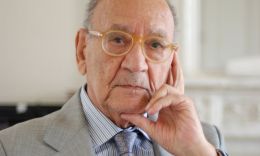
Moustafa Safouan

- The analyst's desire as function
- Feminine jouissance and ravage
- Psychoanalysis as textual science
- Critique of group psychology and the pass
- Jacques Lacan and the Question of the Training of Analysts (1983)
- The Word or Death (1996)
- Why the Arab World Is Not Free (2008)
- Psychoanalysis: Science, Therapy — and Cause (2013)
- Shakespeare’s Othello into Egyptian Arabic
Moustafa Safouan (Arabic: مصطفى صفوان; May 17, 1921 – November 7, 2020) was an Egyptian-born Lacanian psychoanalyst, philosopher, and translator whose work fundamentally redefined the parameters of analytic training, institutional ethics, and the relationship between language and jouissance. One of the earliest and most rigorous interlocutors of Jacques Lacan, Safouan played a decisive role in the postwar transmission of psychoanalysis, particularly through his critical interrogation of the "pass" and the Subject-supposed-to-know. His intellectual project was characterized by a "critical fidelity" to the Freudian discovery, which he articulated not as a body of dogma but as a "textual science" grounded in the singularity of speech and the traversal of fantasy.
Safouan is equally recognized for his efforts to de-colonize and recontextualize psychoanalytic thought; he produced the first Arabic translation of Sigmund Freud's The Interpretation of Dreams and theorized the political impasses of the Arab world through the lens of linguistic foreclosure and the symbolic law. Across seven decades of clinical and theoretical practice, Safouan remained a staunch opponent of bureaucratic credentialing, arguing instead for an ethics of the analytic act that privileges subjective division over institutional mastery.[1][2]
Biography
Early Life and Education
Moustafa Safouan was born in Alexandria, Egypt, into an intellectually vibrant and politically dissident milieu. His father, a teacher and communist activist, was imprisoned for political activities in 1924, an event that Safouan later identified as a formative encounter with the weight of the Law and state repression. He received a classical education in Arabic literature and Western philosophy at the University of Alexandria.
It was in Alexandria that Safouan met Moustapha Ziwar, the first Egyptian member of the International Psychoanalytical Association (IPA). Ziwar served as Safouan’s first mentor, introducing him to Freudian theory and encouraging him to pursue formal training in Europe. This early exposure was marked by the cultural tensions of late-colonial Egypt, where Islamic reformism, early feminism, and Marxist thought intersected—a background that would later inform Safouan's psychoanalytic critiques of authoritarianism.[3]
Entry into Psychoanalysis
In 1946, Safouan moved to Paris to study philosophy at the Sorbonne under figures such as Émile Bréhier and Alexandre Koyré. Shortly after his arrival, he entered a didactic analysis with Marc Schlumberger, a member of the Société Psychanalytique de Paris (SPP). However, Safouan’s decisive theoretical orientation was catalyzed by his encounter with Jacques Lacan in 1947. Attending Lacan’s clinical presentations, Safouan was struck by the departure from the "ego psychology" then dominant in the IPA, gravitating instead toward Lacan's emphasis on the unconscious as a linguistic structure.
By 1949, Safouan was under Lacan’s direct supervision and became an active participant in the nascent seminars at rue de Lille. He was part of the foundational group that would eventually break from the SPP to form the Société Française de Psychanalyse (SFP) and, later, the École Freudienne de Paris (EFP). During this period, he was recognized as one of Lacan’s most gifted students, tasked with recording and synthesizing several of the early seminars.
Exile and Translation
The trajectory of Safouan's career was interrupted in 1953 when political instability in Egypt under the Nasser regime resulted in a five-year period of forced exile in Cairo. During this time, he was appointed to a teaching post at Cairo University, where he faced the challenge of introducing psychoanalysis to a culture lacking a technical Freudian lexicon.
In 1955, Safouan published the first Arabic translation of Freud's The Interpretation of Dreams (Tafsir al-Ahlam). This was more than a philological task; it was an epistemic intervention that forced Safouan to reconcile the "universal" claims of psychoanalysis with the specificities of Arabic grammar and the Islamic symbolic order. This period solidified his view of psychoanalysis as a "textual science" that must be reinvented within each linguistic context.[4]
Later Career and Affiliations
Safouan returned to France in 1958, rejoining the Lacanian circle at the height of its "return to Freud." Following the "Great Split" and the founding of the EFP in 1964, Safouan relocated to Strasbourg. This geographic distance from the "court politics" of the Parisian Lacanian scene allowed him to maintain a position of principled autonomy. In Strasbourg, he collaborated with Didier Anzieu and Lucien Israel, establishing a robust regional center for analytic training that resisted the increasing bureaucratization of the central school.
Though he remained a member of the EFP until its dissolution in 1980, Safouan became a vocal internal critic of the school’s implementation of "the pass"—a procedure intended to verify the end of analysis. He argued that the EFP had succumbed to "group psychology," where the desire for institutional recognition had supplanted the ethics of the analytic act. Following Lacan’s death, Safouan refused to join the newly formed École de la Cause freudienne (ECF), choosing instead to work within independent formations, emphasizing a "non-identificatory" approach to analytic transmission.
Engagement with Psychoanalysis
The Ethics of the Act
Safouan’s engagement with psychoanalysis was defined by the rejection of the analyst as an expert or a "subject supposed to know." He maintained that the efficacy of the cure is not found in the analyst's knowledge but in the analyst's ability to sustain the place of the Real—the void around which the subject’s desire is structured. For Safouan, the analytic act is an ethical intervention that aims at symbolic castration: the subject’s realization that the Other does not hold the ultimate key to their being.[5]
Psychoanalysis as "Textual Science"
A consistent theme in Safouan’s work is the critique of "mathematization" in psychoanalysis. While Lacan increasingly turned toward mathemes and topology to formalize analytic knowledge, Safouan remained wary of any formalization that bypassed the singular, "equivocal" nature of speech. He argued that psychoanalysis is a "textual science," meaning its truths are not universal laws but are inextricably tied to the "text" of the patient’s speech. In this view, concepts such as the Oedipus complex or the Phallus are not biological or sociological facts but linguistic functions that only acquire meaning through their specific articulation in the transference.
Institutional Critique
Safouan is perhaps the most significant theorist of the "failure" of Lacanian institutions. Drawing on Freud’s Group Psychology and the Analysis of the Ego, he diagnosed the tendency of analytic schools to devolve into "churches" centered on the idealization of a master-figure. He famously argued that "psychoanalysis is not transmitted—it is invented," suggesting that an institution can at best provide the conditions for this invention rather than certify it through hierarchical titles. His 1983 work, Jacques Lacan and the Question of the Training of Analysts, remains the definitive critique of how the "pass" was betrayed by the institutional narcissism of the EFP.[6]
The Arab Context and the Law
Unique among his contemporaries, Safouan applied psychoanalytic logic to the sociopolitical structure of the Arab world. He argued that the absence of political freedom in Arab societies was linked to a specific "linguistic alienation"—the gap between the written, sacred language (fus’ha) and the spoken vernacular (‘ammiya). He theorized that this bifurcation prevents the "Word" from functioning as a true Symbolic Law, leaving the subject caught between an unreachable Ideal and a chaotic, authoritarian Real. This work positioned Safouan as a bridge between European psychoanalysis and post-colonial political theory.
IV. Theoretical Contributions
A. Training and the Analyst's Desire
Safouan’s most sustained theoretical intervention concerns the production of the analyst. In his 1983 seminal text, Jacques Lacan and the Question of the Training of Analysts, he argues that psychoanalytic formation is a structural paradox: while the school must provide a framework for study, the "analyst" is not a product of pedagogical transmission. For Safouan, training consists of a movement toward the collapse of the Subject-supposed-to-know. If the analysand enters treatment assuming the analyst possesses the secret of their truth, the end of analysis consists in the realization that this knowledge is a semblance.
The analyst's desire, in Safouan’s reading, is not a professional vocation or a therapeutic "will to cure." Rather, it is a structural function—an "empty place"—that allows the patient to confront the void of their own division. He maintains that the analyst is only "authorized" by the traversal of their own fantasy, which results in a symbolic dis-identification from all institutional and social titles. This leads to his defense of Lacan's maxim that "the analyst authorizes himself by himself," a statement Safouan interprets as an ethical requirement rather than a license for clinical anarchy.[7]
B. Group Psychology and Institutional Failure
Drawing heavily on Freud’s Group Psychology and the Analysis of the Ego (1921), Safouan diagnosed the structural fragility of psychoanalytic organizations. He argued that the "school" is constantly threatened by the return of the Ideal Ego, where members identify with the leader (Lacan) or a specific doctrine to avoid the anxiety of their own non-knowledge.
Safouan provided a rigorous post-mortem of the École Freudienne de Paris (EFP), asserting that the institution failed not because of Lacan’s theories, but because the group could not sustain the radical nature of the pass. Instead of being a testimonial of the end of analysis, the pass was bureaucratized into a ritual of social promotion. Safouan famously summarized this impasse with the aphorism: "Psychoanalysis isn't transmitted—it's invented." This implies that each analyst must reinvent the field from the ground up within the singularity of their own clinical experience, rather than inheriting it as a fixed property.[8]
C. Feminine Sexuality and Ravage
Safouan’s work on femininity is noted for its rejection of pre-Oedipal "maternalist" theories. He remained faithful to the Lacanian thesis that there is no "Other of the Other"—meaning there is no feminine essence outside the mediation of the signifier. However, he expanded the concept of Ravage to describe the specific devastation found in the mother-daughter relationship.
He theorized ravage as a consequence of the daughter’s demand for the mother to provide a signifier for her desire. When the mother remains an "absolute Other" whose desire is unmediated by the Name-of-the-Father, the daughter is left in a state of psychic ruin. Safouan argues that feminine sexuality is not defined by "penis envy" in a biological sense, but by the subject’s relation to a jouissance that remains "Other" to the phallic function. In his view, the analytical task is to move the subject from the position of ravage to a recognition of the limits of the Symbolic order.[9]
D. Language, Law, and the Real
In The Word or Death (1996), Safouan develops a theory of the "Symbolic Law" as the only barrier against the lethal nature of the drive. He argues that the human subject is faced with a choice: the mediation of the word (which entails castration and the loss of primordial jouissance) or the silence of "death" (the unmediated excess of the drive).
Safouan rejects the idea that psychoanalysis can be a "formal science" like physics. He labels it a textual science, asserting that its "Real" is not a mathematical constant but the failure of speech itself. This led to his controversial critique of the Arab world, where he argued that the institutionalized repression of vernacular speech (‘ammiya) in favor of a sacred, static classical Arabic (fus’ha) mirrors the structure of a "foreclosed" law. Without a living language that can be questioned and reinvented, Safouan argued, the subject is left vulnerable to authoritarianism and the "dark gods" of religious fanaticism.[10]
V. Clinical and Institutional Work
Safouan practiced for decades in Strasbourg, occupying a position as a "training analyst" who remained deeply skeptical of the title itself. His clinical stance was characterized by an extreme neutrality, aimed at preventing the patient from identifying with the analyst’s person. He viewed the analyst’s interventions not as explanations, but as "cuts" intended to displace the subject's certainty.
Institutionally, he remained a "free electron" after the 1980 dissolution of the EFP. While he maintained respect for Jacques-Alain Miller, he distanced himself from the World Association of Psychoanalysis (WAP), fearing that its "One-man" leadership model would repeat the group-psychological failures he had analyzed in the 1970s. He became a reference point for independent Lacanian circles in France, Belgium, and Brazil, advocating for a "minimalist" institution that serves only to facilitate clinical control (supervision) and the reading of texts.
VI. Influence and Legacy
Safouan’s legacy is twofold. In Europe, he is remembered as the "conscience of the Lacanian movement," the analyst who refused to sacrifice clinical rigor for institutional power. His work on the training of analysts remains a mandatory reference for any study of Lacanian history.
In the Arab world, Safouan is a pioneering figure who proved that psychoanalysis could be a tool for cultural and political liberation. By translating Freud into Arabic and critiquing the linguistic structures of the Middle East, he opened a path for a non-Western psychoanalysis that does not lapse into cultural relativism. His death in 2020 marked the end of the "heroic age" of Lacanianism, yet his writings continue to provide a blueprint for a psychoanalysis grounded in the ethics of the word.[11]
VII. Key Works
Jacques Lacan and the Question of the Training of Analysts (1983): A rigorous analysis of the EFP's failure and the ethics of the "pass."
The Word or Death (1996): A philosophical and psychoanalytic study of the foundation of the social bond in language.
Four Lessons of Psychoanalysis (2004): A pedagogical yet dense introduction to the core concepts of the Lacanian orientation.
Why the Arab World Is Not Free (2008): A controversial application of psychoanalysis to the linguistic and political history of the Arab world.
Psychoanalysis: Science, Therapy — and Cause (2013): A late synthesis of Safouan’s views on the epistemological status of the field.
VIII. See also
IX. References
- ↑ Roudinesco, É., Jacques Lacan: Esquisse d’une vie, histoire d’un système de pensée, Paris: Fayard, 1993.
- ↑ Safouan, M., Jacques Lacan and the Question of the Training of Analysts, London: Macmillan, 1983.
- ↑ Safouan, M., Why the Arab World Is Not Free: Curving Depots and Lost Narratives, Seattle: University of Washington Press, 2007.
- ↑ Safouan, M., Psychoanalysis: Science, Therapy — and Cause, London: Karnac Books, 2013.
- ↑ Safouan, M., "On the Formation of the Psychoanalyst," Address to the Strasbourg Lacanian Formation, 2003.
- ↑ Safouan, Jacques Lacan and the Question of the Training of Analysts, ch. 4.
- ↑ Safouan, M., Jacques Lacan et la question de la formation des analystes, Paris: Seuil, 1983, pp. 88–92.
- ↑ Safouan, M., "L'échec de la passe," in La psychanalyse est-elle une science ?, Paris: Flammarion, 1993.
- ↑ Safouan, M., "Questions Concerning Feminine Sexuality," interview with the Centre for Freudian Analysis and Research (CFAR), 2004.
- ↑ Safouan, M., Le mot ou la mort, Paris: Seuil, 1996.
- ↑ Éribon, D., "Moustafa Safouan: La force de la parole," Le Monde, November 2020.
X. External Links
Interview: “Questions Concerning Feminine Sexuality” – CFAR