Lacanian psychoanalysis
Lacanianism, also known as Lacanian psychoanalysis, is a theoretical and clinical system of psychoanalysis initiated by the work of the French psychiatrist and psychoanalyst Jacques Lacan (1901–1981). Spanning from the 1930s to the 1980s, Lacanianism represents a "return to Freud" mediated through the lenses of structuralism, linguistics, Hegelian philosophy, and topology.
Central to Lacanian theory is the contention that the human subject is not an autonomous entity but is fundamentally constituted by the "Other"—the world of language and social laws known as the Symbolic. Lacanianism is distinct from other major post-Freudian schools, such as ego psychology and object relations theory, in its rejection of the ego as a site of adaptation or synthesis. Instead, Lacanians view the ego as a construct of "misrecognition" and define the unconscious not as a reservoir of biological instincts, but as a structure organized like a language.
Lacanianism has exerted a profound influence on critical theory, literary theory, film studies, and feminist theory. Clinically, it remains a dominant force in France and much of Latin America (particularly Argentina and Brazil), though it has historically held a more marginal position in the psychiatry of the English-speaking world.[1]
Historical Context
See main article: Jacques Lacan
The development of Lacanianism is often categorized into three phases, corresponding roughly to Lacan's shifting theoretical focus from the Imaginary (1930s–40s), to the Symbolic (1950s), and finally to the Real (1960s–70s).[2]
Origins: Surrealism and Psychiatry (1930s–40s)
Lacan's entry into psychoanalysis was rooted in French psychiatry and the avant-garde artistic movements of interwar Paris. His doctoral thesis (1932) on paranoia examined the relationship between psychosis and personality, heavily influenced by the Surrealist interest in "convulsive beauty" and madness. During this period, Lacan attended the lectures of Alexandre Kojève on Hegel, which introduced the concept of desire as a "desire for recognition"—a dialectic that would later underpin Lacan's theory of the subject's relationship to the Other.[3]
His first major contribution to psychoanalytic theory was the Mirror stage, presented at the International Psychoanalytical Association (IPA) congress in Marienbad in 1936. This concept challenged the prevailing view of the ego as a biological development, proposing instead that the "I" is constructed through an external image.
The Structuralist Turn (1950s)
In the early 1950s, Lacan initiated his famous "Return to Freud" (retour à Freud). He argued that post-Freudian analysts—particularly the ego psychology school dominant in the United States—had betrayed Freud's discovery of the unconscious by focusing on social adaptation and strengthening the ego.
To reclaim the radical nature of Freud's work, Lacan adopted the tools of structuralism, particularly the structural linguistics of Ferdinand de Saussure and the structural anthropology of Claude Lévi-Strauss. In his seminal 1953 report, The Function and Field of Speech and Language in Psychoanalysis (often called the Rome Discourse), Lacan reframed psychoanalysis as a practice of speech, asserting that the subject is an effect of the signifier. This period marks the formalization of the Lacanian clinic, focusing on the symbolic order of kinship, culture, and law.[4]
The Split with the IPA and the Founding of the EFP
See main article: Jacques Lacan and the IPA
Lacanianism developed as a distinct institution due to increasing friction with the orthodox psychoanalytic establishment. The primary point of contention was Lacan's use of the variable-length session (or "short session"). While standard IPA practice dictated sessions of a fixed 50-minute duration, Lacan argued that the analyst should punctuate the session based on the patient's speech (scansion), sometimes ending sessions after only a few minutes to emphasize a specific signifier.
In 1963, the IPA demanded that the French association remove Lacan from its list of training analysts as a condition for recognition. Refusing to compromise on his technique, Lacan left the organization. In 1964, he founded his own school, the École Freudienne de Paris (EFP), declaring himself "alone as I have always been in my relation to the psychoanalytic cause." This moment marks the official birth of Lacanianism as an independent movement.[5]
The Three Registers (RSI)
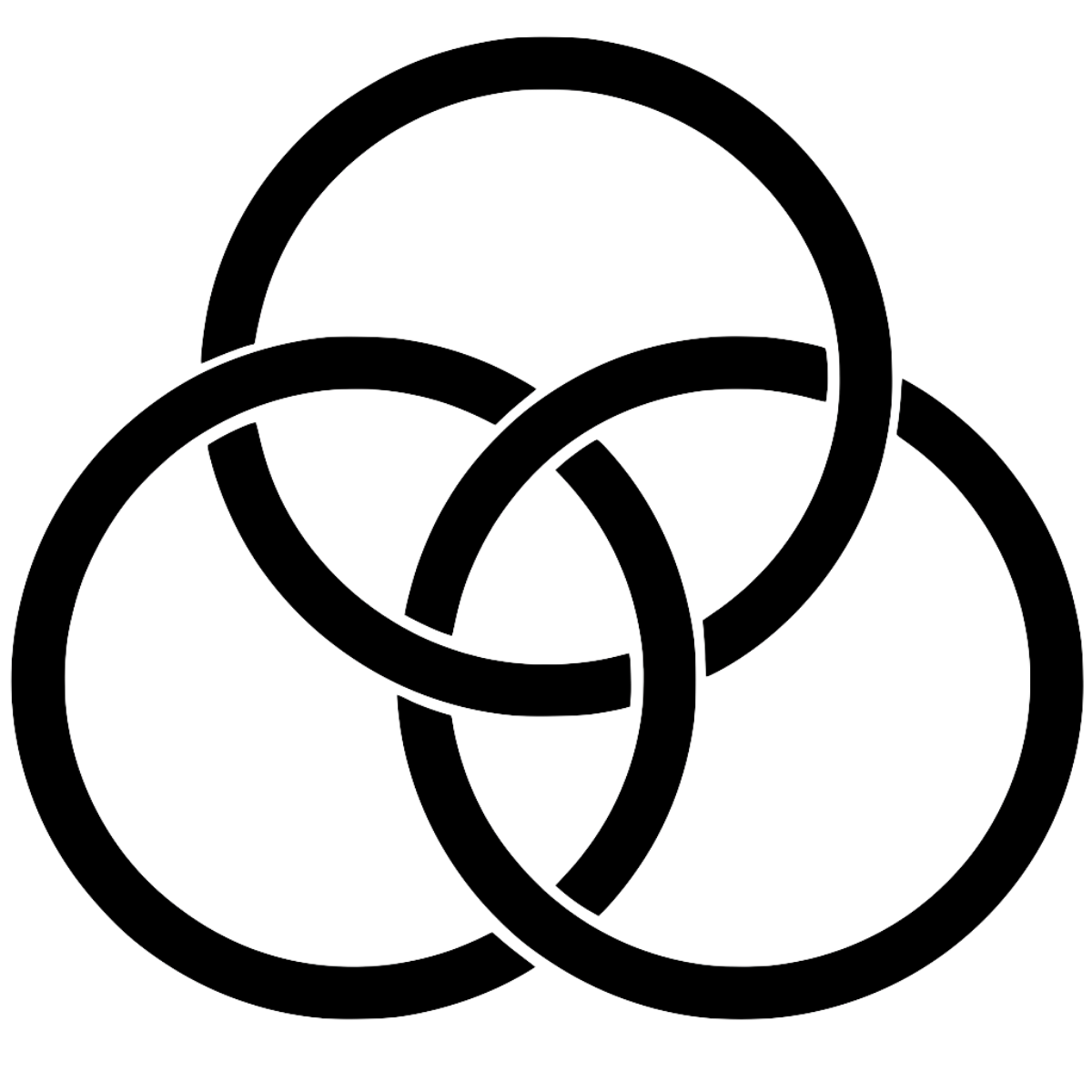
Lacanian theory categorizes psychical reality into three distinct but knotted orders: the Imaginary, the Symbolic, and the Real. Lacan insisted that these registers are inseparably intertwined; in his later teaching, he utilized the topological figure of the Borromean knot to demonstrate that if one ring (register) is cut, the entire structure dissolves.
The Imaginary
See main article: The Imaginary (psychoanalysis)
The Imaginary is the order of images, surface appearances, and deception. It is the register in which the ego is constituted. Originating in the mirror stage, the Imaginary is defined by the subject's identification with an external image (the specular image) that appears whole and coordinated, in contrast to the infant's actual experience of a fragmented body.
Relationships in the Imaginary are characterized by dualism and alienation. The subject sees itself in the other, leading to a dynamic of aggressive tension: "It's either me or the other." Because the ego is built on this identification with an external image, Lacanians argue that the ego is fundamentally a site of "misrecognition" (méconnaissance), rather than the seat of agency or truth.[6]
The Symbolic
See main article: The Symbolic
The Symbolic is the register of language, the law, and the social order. While the Imaginary involves a dual relationship (self/image), the Symbolic introduces a triad through the intervention of the "Third"—the symbolic authority that separates the child from the mother. Lacan refers to this authority as the Name-of-the-Father.
In Lacanianism, the subject is "born into" the Symbolic; the world of language precedes the individual's existence (e.g., through naming conventions and family history). The Symbolic is structured by signifiers (words, sounds, symbols) that connect to one another in a chain. It is in this register that the subject is "barred" or divided () by language, sacrificing immediate access to enjoyment (jouissance) in exchange for meaning and social viability.
The "big Other" (grand Autre, designated as A) belongs to the Symbolic. It represents the radical alterity of language and the law—the place from which speech originates and where truth is established.
The Real
See main article: The Real
The Real is the most complex and contested of the three registers. It is strictly distinguished from "reality" (which is a fantasy constructed by the Imaginary and Symbolic). The Real is that which resists symbolization absolutely. It is the raw, chaotic, or traumatic dimension of existence that cannot be put into words or captured in an image.
In the 1950s, the Real was somewhat peripheral to Lacan's focus on the Symbolic, but by the 1960s and 1970s, it became the focal point of his teaching. The Real is associated with:
- Trauma: An encounter that disrupts the symbolic order.
- Anxiety: The sensation of the Real encroaching on the subject.
- Jouissance: An excessive, painful pleasure that lies beyond the pleasure principle.
Because the Real cannot be mediated, it is often described as the "impossible." Clinical practice in later Lacanianism focuses on how the subject manages their encounter with the Real pieces of their experience that do not make sense (the Sinthome).[7]
Core Concepts
Lacanian theory introduces a distinct vocabulary to describe the mechanisms of the psyche. These concepts reformulate Freudian ideas to emphasize the role of language and structural lack.
The Unconscious Structured Like a Language
See main article: Unconscious (Lacanian)
Perhaps the most famous dictum of Lacanianism is that "the unconscious is structured like a language." This does not mean the unconscious contains words stored in a hidden part of the brain, but rather that it operates according to linguistic laws. Drawing on the linguistics of Roman Jakobson, Lacan aligns the two primary mechanisms of the unconscious identified by Freud—condensation and displacement—with the linguistic figures of metaphor and metonymy.
- Metaphor (Condensation): One signifier substitutes for another, creating new meaning (e.g., the symptom is a metaphor).
- Metonymy (Displacement): Meaning slides from one signifier to the next along a chain, representing the eternal deferral of desire.
Because the unconscious is linguistic, Lacanians argue that the only way to access it is through the signifier—the specific words, slips of the tongue, and speech patterns of the analysand.
Desire, Demand, and Need
See main article: Desire (Lacanian)
Lacan creates a crucial tripartite distinction to explain human motivation:
- Need (besoin): A biological instinct (e.g., hunger) that can be fully satisfied by a specific object (e.g., food).
- Demand (demande): The articulation of need through language. When a subject asks for something, they are also implicitly asking for love and recognition from the Other. Because demand addresses the Other, it can never be fully satisfied by the object alone.
- Desire (désir): The surplus that remains after need is subtracted from demand. Desire is born from the gap between the biological need and the demand for love. Unlike need, desire has no object that can satisfy it; it is a constant force of lack.[8]
Lacan famously asserts that "Man's desire is the desire of the Other" (le désir de l'homme est le désir de l'Autre). This implies both that the subject desires to be the object of another's desire (recognition) and that the subject's desires are shaped by the desires they perceive in the social world.[9]
Objet petit a
See main article: Objet petit a
The objet petit a (object small a) is the "object cause of desire." It is not the object towards which desire tends, but the cause that sets desire in motion. It represents the void or gap left behind when the subject enters the Symbolic order.
Because the subject is permanently divided by language, they constantly seek to fill this lack with various empirical objects (wealth, partners, prestige). However, the objet petit a itself is ungraspable—it is the "agalma" or surplus enjoyment that slips away. In the clinic, the objet a often manifests as partial objects: the gaze, the voice, the breast, or feces.
The Name-of-the-Father and Foreclosure
See main articles: Name-of-the-Father and Foreclosure (psychoanalysis)
The Name-of-the-Father (Nom-du-Père) is the fundamental signifier that anchors the Symbolic order. It acts as the agent of the law, separating the child from the mother and imposing the "No" (Non) that prohibits incest. This operation is known as the paternal metaphor.
When this signifier is successfully integrated, the subject enters the state of neurosis (the standard condition of the socialized subject). If the Name-of-the-Father is rejected or expelled from the symbolic universe entirely, a mechanism Lacan calls foreclosure (forclusion), the result is psychosis. In psychosis, the Symbolic order does not hold, and the subject may be invaded by the Real (e.g., hallucinations).
Advanced Theory
The Four Discourses
See main article: Four discourses
In his later seminars (specifically Seminar XVII, 1969–1970), Lacan formalized social bonds into four distinct structures called discourses. Each discourse represents a different relationship between the agent of speech, the other, truth, and the product of the interaction.
Using mathemes, the discourses permute four key positions (, , , ):
- Discourse of the Master: The structure of traditional authority and governing.
- Discourse of the University: The structure of bureaucracy and "neutral" knowledge.
- Discourse of the Hysteric: The structure of questioning authority and producing knowledge (the driving force of science).
- Discourse of the Analyst: The structure of the analytic clinic, where the analyst occupies the position of objet a to cause the subject () to produce their own signifiers.
Sexuation
See main article: Lacanian sexuation
Lacan challenged biological essentialism with his formulas of sexuation (Seminar XX). He argued that "man" and "woman" are not biological categories but logical positions relative to the phallic function (castration).
- The Male Side: Defines itself through universality—"all men are subject to castration"—sustained by the fantasy of an exception (the primal father).
- The Female Side: Defines itself through a "not-all" (pas-tout) logic. This does not mean women are incomplete, but that they are not wholly contained by the phallic function, having access to a "supplementary" enjoyment known as Other jouissance.
Clinical Structures
See main article: Lacanian clinical structures
Lacanian diagnosis is strictly structural, not symptomatic. A diagnosis is determined by the subject's fundamental relationship to the Other, established in early childhood. These structures are generally considered stable and mutually exclusive.
Neurosis
Neurosis is defined by the mechanism of repression (verdrängung). The neurotic subject has accepted the Name-of-the-Father but remains conflicted about the loss it entails.
- Hysteria: The subject is consumed by the question of their own existence and sexuation ("Am I a man or a woman?"). The hysteric identifies with the lack in the Other and often refuses satisfaction to keep desire alive.
- Obsession: The subject attempts to deny the lack in the Other through systems, control, and thinking. The obsession is characterized by the question of existence ("Am I alive or dead?").
Psychosis
Psychosis is defined by foreclosure (verwerfung). Because the Paternal Metaphor was never installed, the psychotic subject lacks the "quilting point" (point de capiton) that anchors meaning. Words may be treated as things (the Real), and the subject may experience phenomena such as voices (auditory hallucinations) where the unconscious returns from "outside."
Perversion
Perversion is defined by disavowal (verleugnung). The subject acknowledges the Law/castration but simultaneously denies it ("I know very well, but all the same..."). The pervert positions themselves as the instrument of the Other's enjoyment, often aiming to plug the lack in the Other. This is structurally distinct from the "perverse" acts defined by psychiatry; it is a stable subjective position.[10]
Clinical Practice
See main article: Lacanian clinical technique
Lacanian clinical practice is famously rigorous and distinct from the supportive or pedagogical approaches found in other schools of therapy. The focus is exclusively on the subject's speech and the emergence of unconscious truth.
The Variable-Length Session (Scansion)
The most controversial innovation in Lacanian technique is the variable-length session (often called the "short session"). Lacan rejected the standard 50-minute hour, arguing that it allowed patients to fill time with empty chatter or "planning" their speech.
Instead, the Lacanian analyst uses scansion (punctuation) to end the session at a precise moment—often when a significant signifier, slip of the tongue, or moment of hesitation occurs. This cut stops the flow of meaning, forcing the analysand to confront the implications of what they have just said. The session may last 40 minutes or 5 minutes; the duration is determined by the logic of the unconscious rather than the clock.[5]
The Position of the Analyst
The Lacanian analyst does not offer empathy, advice, or a model for identification. Instead, the analyst occupies the position of the dummy or "the dead hand" (bridge player metaphor), eventually coming to stand in for the objet petit a.
By refusing to respond to the analysand's demand for love or answers, the analyst frustrates the patient. This frustration is necessary to drive the patient away from the Imaginary (the desire to be liked/understood) and toward the Symbolic (the articulation of their own desire).
The Pass (La Passe)
In 1967, Lacan introduced "The Pass," a procedure to institutionalize the end of analysis and the authorization of new analysts. Instead of a hierarchy of training analysts certifying students, the candidate (the "passand") testifies about their analytic experience to two peers (the "passers"), who then relay this testimony to a jury. The goal was to capture the moment when a patient transforms into an analyst, specifically examining how they have navigated the "traversal of the fantasy."
Institutional History & Contemporary Schools
The institutional history of Lacanianism is marked by intense loyalty, bitter schisms, and complex genealogy.
The Dissolution of the EFP
In 1980, one year before his death, Lacan unilaterally dissolved the École Freudienne de Paris (EFP), claiming it had fallen into the "glue" of group psychology and deviation. He launched a new organization, the Cause Freudienne, shortly before he died.
The Millerian Orientation
Following Lacan's death, his son-in-law and literary executor, Jacques-Alain Miller, assumed a central role. Miller founded the École de la Cause Freudienne (ECF) in Paris and established the World Association of Psychoanalysis (WAP). This "Millerian" orientation is characterized by a rigorous adherence to the late Lacan's teachings, the precise transcription of the Seminars, and a centralized international structure.
Pluralist Movements
Many of Lacan's original students rejected Miller's authority, leading to a proliferation of other schools. Notable groups include:
- Association Lacanienne Internationale (ALI): Founded by Charles Melman.
- Espace Analytique: Founded by Maud Mannoni.
- Quatrième Groupe: Founded by Piera Aulagnier and François Perrier (historically split earlier, in 1969).
Global Reception
Lacanianism is the dominant form of psychoanalysis in France, Argentina, and Brazil. In the English-speaking world (UK, USA), Lacanianism has historically been more influential in universities (Humanities departments) than in clinical psychiatry, though clinical training institutes exist in London (CFAR) and various US cities (Lacanian School of Psychoanalysis).
Criticism
See main article: Criticism of Lacanianism
Feminist Critiques
Lacanianism has a complex relationship with feminism. Early critics like Luce Irigaray (a former student of Lacan) argued that Lacan's reliance on the Phallus as the prime signifier perpetuated a "phallocentric" worldview that rendered female sexuality invisible or secondary. However, later feminists (e.g., Jacqueline Rose, Juliet Mitchell) argued that Lacan provides the best tools for understanding how patriarchy constructs gender, rather than endorsing it.[11]
Deleuze and Guattari
In their seminal work Anti-Oedipus (1972), Gilles Deleuze and Félix Guattari (a former student of Lacan) launched a blistering critique of psychoanalysis. They argued that Lacan's focus on "lack" (manque) was a theological error that stifled the productive, positive nature of desire. They proposed "schizoanalysis" as an alternative to the "Oedipalizing" structures of Lacanianism.
Obscurantism
Lacan is frequently criticized for his difficult, baroque style. Critics like Noam Chomsky and Alan Sokal have accused Lacan of "posturing" and misusing mathematical concepts (topology, logic) to create an illusion of scientific rigor without substance. Lacanians defend this style as a deliberate attempt to mirror the complexity of the unconscious and prevent the reduction of psychoanalysis to simplistic "sound bites."
Legacy & Influence
Philosophy and Critical Theory
Lacan's work is a cornerstone of continental philosophy. Slavoj Žižek is the most prominent contemporary philosopher using Lacanian categories to analyze pop culture, ideology, and global politics. Alain Badiou has integrated Lacan's theory of the subject into his own mathematical ontology.
Film Theory and Literature
In the 1970s, Lacanian concepts like the "Gaze" and the "Mirror Stage" revolutionized film theory (e.g., Christian Metz, Laura Mulvey), providing a framework to understand how cinema constructs the viewer's identity.
Queer Theory
Contemporary queer theory (e.g., Lee Edelman, Tim Dean) has increasingly turned to Lacan—specifically his later formulas of sexuation—to theorize non-normative sexualities and the fluidity of gender beyond biological determinism.
See Also
References
- ↑ Template:Cite web
- ↑ Mellard, James M. Beyond Lacan. State University of New York Press, 2006, p. 49.
- ↑ Kojève, Alexandre. Introduction to the Reading of Hegel. Basic Books, 1969, p. 39.
- ↑ Élisabeth Roudinesco, Jacques Lacan & Co: A History of Psychoanalysis in France, 1925-1985. University of Chicago Press, 1990.
- ↑ 5.0 5.1 Macey, David. Introduction, in Jacques Lacan, The Four Fundamental Concepts of Psychoanalysis. Penguin, 1994, p. xiii.
- ↑ Lacan, J., "Some Reflections on the Ego" in Écrits.
- ↑ Jacques Lacan, The Four Fundamental Concepts of Psycho-Analysis. W. W. Norton & Company, 1994, p. 280.
- ↑ Lacan, J., "The Signification of the Phallus" in Écrits.
- ↑ Lacan, J. The Seminar: Book XI. The Four Fundamental Concepts of Psychoanalysis, 1964. W. W. Norton & Company, 1998.
- ↑ Fink, Bruce. A Clinical Introduction to Lacanian Psychoanalysis. Harvard University Press, 1997.
- ↑ Grosz, Elizabeth (1990). Jacques Lacan: A Feminist Introduction. London: Routledge.
Further Reading
- Fink, Bruce. The Lacanian Subject: Between Language and Jouissance. Princeton University Press, 1995.
- Evans, Dylan. An Introductory Dictionary of Lacanian Psychoanalysis. Routledge, 1996.
- Roudinesco, Élisabeth. Jacques Lacan. Columbia University Press, 1997.
- Žižek, Slavoj. How to Read Lacan. Granta, 2006.